
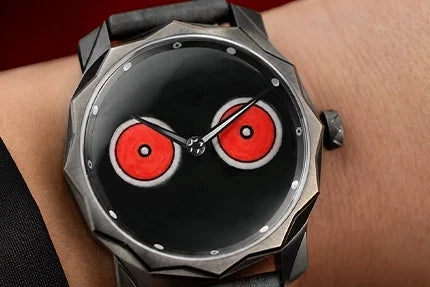
There is something inherently unstable about MOTOMICHI’s Red Eyes.
They appear simple at first: two red points emerging from an expanse of darkness. Yet their visual economy is precisely what gives them their force. The eyes do not describe a face. They do not provide a body, an expression or even a clear identity. Instead, they establish a presence.
They stare.
For years, MOTOMICHI’s visual language has occupied the immaterial territory of contemporary new-media art: digital projection, moving images and interventions in which characters emerge across walls, landscapes and architectural surfaces.
In these environments, the image is never entirely fixed. It depends upon light, scale, duration and the physical space onto which it is projected.
With the Solune Grand Art MOTOMICHI — Red Eyes, created with Schaefer & Companions, that relationship is deliberately inverted.
The projection becomes an object.
The wall becomes a dial.
And an image once composed from light is translated into matter.
The result is not simply an artist collaboration applied to a watch. It is a study in what happens when one artistic language is forced to inhabit another.

From projection to object
A digital projection exists through disappearance.
Switch off the projector and the image ceases to exist.
Mechanical watchmaking operates almost according to the opposite principle. Its culture is built around physical permanence: steel, gears, polished surfaces, pigments and gestures intended to remain long after their makers have disappeared.
The collaboration between MOTOMICHI and Schaefer & Companions therefore begins with a contradiction.
How can an image whose identity is inseparable from light become a permanent mechanical object without losing its original tension?
Rather than reproducing a MOTOMICHI artwork as a conventional decorative dial, the project preserves the essential mechanisms behind the artist’s work: darkness, apparition, transformation and gaze.
At the centre of the watch, two eyes appear against black.
Almost nothing else is required.
The radical simplicity of the composition makes the dial feel less like a miniature illustration than a fragment extracted from one of MOTOMICHI’s projections.
Its power lies in what has deliberately been omitted.
There is no complete character to contextualise the gaze. No environment to explain it. No narrative to resolve it.
Only the eyes remain.
And on the wrist, their relationship with the viewer becomes considerably more intimate.

A watch that reverses the gaze
We normally understand a watch through an act of looking.
The wearer raises the wrist, observes the dial and extracts information from it. The object remains passive.
Red Eyes disrupts that familiar relationship.
The moment the eyes occupy the dial, the psychological direction of observation changes.
The wearer is no longer simply looking at the watch.
The watch appears to look back.
This reversal is fundamental to the work.
MOTOMICHI’s figures frequently possess the ambiguous quality of creatures caught between innocence and unease. Their reduced forms are immediately accessible, yet their staring eyes introduce a slight psychological instability.
Transferred onto the wrist, this ambiguity becomes almost bodily.
The watch sits directly against the skin. It moves with the hand. It disappears beneath a sleeve and reappears. It accompanies its wearer through changing environments and changing light.
The artwork is no longer encountered occasionally in an exhibition.
It becomes something carried.
Something inhabited.

André Martinez: translating pixels into pigment
The transformation from digital image to physical object is made possible through the work of métiers d’art artisan André Martinez.
His role in the project is not simply to reproduce MOTOMICHI’s imagery at a smaller scale.
It is to translate it.
Working at the dimensions of a watch dial fundamentally changes the nature of an image. A form that appears immediate on a monumental projection must now survive within only a few millimetres.
Edges, proportions, density and visual balance behave differently.
Every gesture becomes visible.
Every irregularity becomes meaningful.
André individually micro-paints each eye by hand, interpreting MOTOMICHI’s graphic language through the precision and material sensitivity of traditional horological métiers d’art.
This introduces something that does not exist in the original digital file: the trace of the human hand.
Pixels are theoretically repeatable.
A hand-painted surface is not.
Two gestures may follow the same intention, yet they will never be completely identical.
Under magnification, the apparent simplicity of Red Eyes therefore reveals another dimension. Pigment has thickness. Boundaries possess microscopic variations. The image acquires a physical skin.
The digital icon becomes material.

The significance of the handmade imperfection
In industrial production, variation is generally treated as an error.
Within artistic craftsmanship, variation can become evidence.
The microscopic differences created through André Martinez’s hand are not defects to be eliminated; they are signs of authorship and process.
That distinction is particularly important in the context of an artwork originating in digital media.
Digital imagery is associated with perfect reproduction. A visual file can theoretically be duplicated indefinitely without altering its fundamental information.
Micro-painting breaks that logic.
Each execution introduces irreversibility.
The image is no longer merely reproduced.
It is performed.
In this sense, André Martinez creates the physical bridge between MOTOMICHI’s contemporary art and Schaefer & Companions’ independent Swiss watchmaking.
The dial is where two apparently distant traditions meet: the infinitely reproducible language of digital imagery and the singular gesture of the artisan.
Painting with darkness
The most conceptually significant element of the dial may only reveal itself when much of the rest disappears.
Super-LumiNova is incorporated directly into the artwork.
Rather than being treated as a conventional luminous indication added to hands or hour markers, the luminescent material participates in the image itself.
This distinction matters.
In traditional watchmaking, lume is primarily functional. Its purpose is to preserve readability when ambient light falls.
Here, it becomes narrative material.
As darkness replaces daylight, the visual hierarchy of the watch changes.
The case recedes.
The dial disappears.
The mechanical object becomes increasingly difficult to perceive.
And the eyes remain.
What is normally a practical technology becomes a method of artistic transformation.
The watch possesses two states: one exposed by light and another revealed by its absence.

The paradox of luminous eyes
There is a particular irony in using stored light to represent something emerging from darkness.
Super-LumiNova absorbs energy while exposed to light and releases it gradually after illumination decreases.
The eyes therefore depend upon light in order to become visible in darkness.
Conceptually, this mirrors the mechanics of digital projection.
A projected MOTOMICHI figure exists because light generates the image.
On the Red Eyes dial, light once again produces the artwork—but through an entirely different physical process.
The projector has disappeared.
Its logic remains.
This is one of the points where the collaboration moves beyond simple visual quotation.
Rather than placing MOTOMICHI’s imagery onto a watch, Schaefer & Companions translates one of the fundamental conditions of his practice—the relationship between image and illumination—into horological material.

The black Solune as a frame
The Schaefer & Companions Solune case plays an intentionally restrained role.
Finished in black, its sculptural architecture extends the darkness of the dial outward until the boundaries between artwork and watch become less obvious.
This monochromatic environment is important.
A conventional polished steel case would frame the artwork visibly. Here, the black Solune attempts almost the opposite: it withdraws.
The case becomes a negative space within which the eyes can exist.
Its curved geometry nevertheless remains perceptible through changes in reflection, allowing the watch to oscillate between object and void.
Seen from a distance, one first encounters the red gaze.
Only afterwards does the architecture of the watch emerge.
This hierarchy mirrors the experience of MOTOMICHI’s projected installations, where an image appears to inhabit a surface rather than simply rest upon it.

The wrist as exhibition space
The transformation of an artwork into a watch also changes its relationship with ownership.
An artwork displayed in a gallery remains spatially anchored.
A watch is mobile.
Its exhibition space is the body of its collector.
The wrist becomes a constantly changing environment: artificial light, sunlight, complete darkness, movement, fabric, skin.
Every condition modifies the appearance of Red Eyes.
This introduces an intimacy that is uncommon even within art watches.
The object does not merely reproduce an artwork at miniature scale. It establishes a continuing relationship between artwork and wearer.
It can be hidden.
Revealed.
Observed by others.
Or encountered privately in darkness.
The artwork becomes simultaneously personal and performative.
Contemporary art meets métiers d’art
The expression métiers d’art is frequently associated with the preservation of historic decorative techniques: engraving, enamelling, marquetry, miniature painting and other forms of highly specialised handcraft.
But preservation does not necessarily require nostalgia.
One of the most interesting possibilities for contemporary métiers d’art lies precisely in its ability to interpret visual languages that did not exist when many of these techniques were developed.
Red Eyes places micro-painting in dialogue with digital culture.
Instead of asking craftsmanship to reproduce a traditional motif, the project asks how traditional manual knowledge can give physical substance to an image born from pixels and projection.
The tension between these worlds gives the watch much of its identity.
It is simultaneously technological and handmade.
Contemporary and traditional.
Repeatable in concept yet singular in execution.
Still in daylight and transformed in darkness.
Independent watchmaking as an artistic medium
For Schaefer & Companions, the project also reflects a broader understanding of independent watchmaking.
A mechanical watch does not need to function solely as an exercise in horological engineering or conventional luxury decoration.
It can become a medium.
The dial provides surface.
The case provides architecture.
The movement introduces time and mechanical life.
The wrist introduces movement and context.
And light introduces transformation.
Seen this way, the watch becomes unusually suited to interdisciplinary artistic collaboration. It is not a static canvas but a small physical environment capable of containing material, motion, reflection and time.
The Solune Grand Art MOTOMICHI — Red Eyes occupies precisely this territory.
It is neither simply a MOTOMICHI artwork reduced to watch dimensions nor a conventional watch carrying an artist signature.
Its meaning exists in the passage between the two.
From screen to wrist
The journey of Red Eyes can ultimately be understood through a sequence of translations.
From digital file to physical pigment.
From projection to micro-painting.
From architectural scale to the intimacy of the wrist.
From emitted light to stored luminescence.
From repeatable image to individually executed object.
Each transition changes the work.
And that change is precisely the point.
The collaboration does not attempt to freeze MOTOMICHI’s visual language inside watchmaking. Instead, it asks what new meanings appear when that language is subjected to another material, another scale and another relationship with its audience.
The answer is an object that remains strangely difficult to classify.
Part watch.
Part miniature painting.
Part mechanical sculpture.
Part luminous apparition.

MOTOMICHI × Schaefer & Companions — Red Eyes
The first Solune Grand Art MOTOMICHI — Red Eyes marks the encounter between MOTOMICHI’s contemporary new-media practice, the micro-painting of André Martinez, and the independent Swiss watchmaking of Schaefer & Companions.
Its first official introduction to the public takes place in Cannes at La Scène des Artistes, in dialogue with MOTOMICHI’s exhibition Friends with the Monster.
The timepiece is currently available for €4,800, taxes included.
Collectors interested in acquiring the piece or learning more about the collaboration can contact Schaefer & Companions directly through our website.
Because some watches are designed to be observed.
This one was designed to return the gaze.


Leave a comment
This site is protected by hCaptcha and the hCaptcha Privacy Policy and Terms of Service apply.